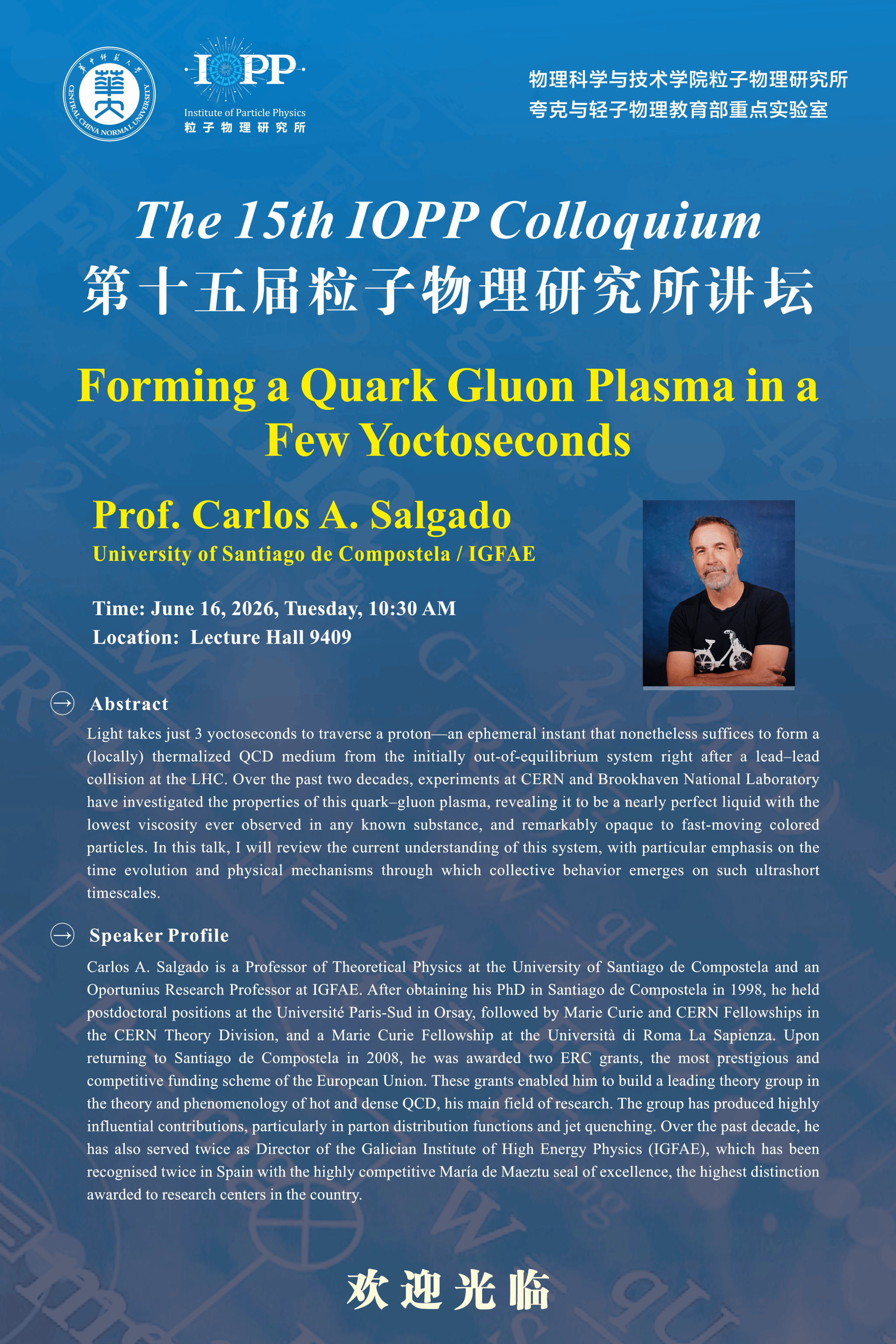
Speker: Prof. Carlos A. Salgado, University of Santiago de Compostela/IGFAE
Time: June 16, 2026, Tuesday, 10:30 AM
Location: Lecture Hall 9409
Abstract:
Light takes just 3 yoctoseconds to traverse a proton-an ephemeral instant that nonetheless suffices to form alocally) thermalized QCD medium from the initially out-of-equilibrium system right after a lead-leadcollision at the LHIC. Over the past two decades, experiments at CERN and Brookhaven National Laboratoryave investigated the properties of this quark-gluon plasma, revealing it to be a nearly perfect liquid with thelowest viscosity ever observed in any known substance, and remarkably opaque to fast-moving coloredarticles. In this talk, I will review the current understanding of this system, with particular emphasis on theime evolution and physical mechanisms through which collective behavior emerges on such ultrashortimescales.
Speaker Profile:
Carlos A. Salgado is a Professor of Theoretical Physics at the University of Santiago de Compostela and anOportunius Research Professor at IGFAE. After obtaining his PhD in Santiago de Compostela in 1998, he heldostdoctoral positions at the Universite Paris -Sud in Orsay, followed by Marie Curie and CERN Fellowships inhe CERN Theory Division, and a Marie Curie Fellowship at the Universita di Roma La Sapienza. Uponreturning to Santiago de Compostela iin 2008, he was awarded two ERC grants, the most prestigious andcompetitive funding scheme of the European Union. These grants enabled him to build a leading theory group inhe theory and phenomenology of hot and dense QCD, his main field of research. The group has produced highlyinfluential contributions, particularly in parton distribution functions and jet quenching. Over the past decade, he1as also scrved twice as Dircctor of the Galician Institute of High Encrgy Physics (IGFAE), which has beenecognised twice in Spain with the highly competitive Maria de Maeztu seal of excellence, the highest distinctionawarded to research centers in the country.